
Safeguarding the Human Person in the Time of Artificial Intelligence
What Christian schools need to hear — and do — right now
There is a question running through every staffroom, every school board meeting, and every teacher's planning session right now, whether it is spoken aloud or not: What does faithfulness look like in the age of artificial intelligence?
This summer, ACSI Europe wants to help you think carefully, biblically, and practically about that question — drawing on some of the most important voices in the conversation, including a landmark document published just weeks ago that every Christian school leader and teacher would benefit from reading.

A new document every educator should know about
On 15 May 2026, Pope Leo XIV released an encyclical letter titled Magnifica Humanitas — "The Magnificence of Humanity" — subtitled On Safeguarding the Human Person in the Time of Artificial Intelligence. It is the first papal encyclical in history to address AI directly and at length, and whatever one's ecclesial tradition, its argument is striking, timely, and deeply consonant with the convictions that animate Christian education across Europe.
The encyclical opens with a choice that will feel familiar to anyone who has thought carefully about the Babel narrative: humanity stands before the option of building another tower of self-sufficient pride, or rebuilding a city under God's sovereign guidance — slowly, together, in the presence of God. Leo XIV writes that "the primary choice is not between a 'yes' or 'no' to technology, but rather between constructing Babel or rebuilding Jerusalem; between a power that claims to dominate the heavens and a people who work together in the presence of God to rebuild the walls of fraternal coexistence."
It is a frame that Christian school leaders will immediately recognise — because it is precisely the frame within which we understand the whole of our educational calling. Christian schools do not exist to produce human capital or optimise student outputs. They exist to form human persons in the image of God, for life in community, for a world that is in desperate need of people who know the difference between a tower and a city.
Chapter Four of Magnifica Humanitas, which focuses on truth, work, and freedom in the age of digital transformation, has a section that speaks directly to the vocation of Christian schools. The encyclical calls for what it terms "an educational alliance for the digital age," insisting on "the central role of schools" in forming people who can navigate a world saturated with AI-generated content, algorithmic decision-making, and the erosion of the distinction between information and truth. It is not a technical argument. It is a deeply human one — and it deserves careful study.
We strongly encourage every school leader and teacher in our network to read Magnifica Humanitas in full. It is available in multiple languages at the Vatican's website and rewards slow, reflective reading. Begin with the Introduction and Chapter Four if time is short — but return to the whole.
The conversation school leaders had at IELC 2026
Those who joined us at IELC in March will remember Professor Marc de Vries's plenary session with particular clarity. A professor emeritus from Delft University of Technology, who spent his career teaching Christian philosophy of technology in secular institutions, Marc opened with an observation that set the tone for everything that followed: science and technology, which were meant to be blessings, have in our time come to function as ideological challenges to faith — presenting themselves not as tools but as rival worldviews. 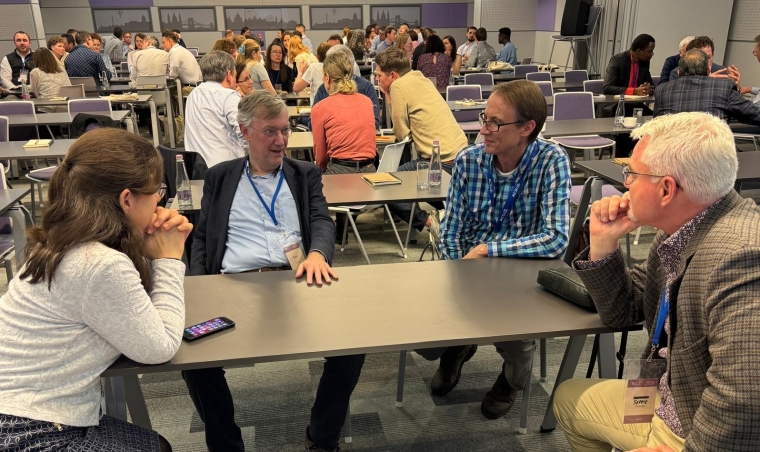
Marc described our cultural moment as a "Babel culture" — an era shaped by the conviction that human ambition, given sufficient processing power, can reach any height without reference to God. The language of modern AI development — "unlimited" data, "boundless" capability, the elimination of human limitation — is not neutral. It borrows the grammar of messianic promise. And Christian school students hear it every day.
His framework for understanding what technology claims to do was arresting: technology has assumed a prophetic role (mediating what we believe about reality), a priestly role (promising liberation from limitation), and a kingly role (claiming dominion over creation itself — most disturbingly in synthetic biology and the engineering of human life). These are not simply ethical concerns about how AI is used. They are theological concerns about what AI is expected to be and to achieve.
For teachers and school leaders, his challenge was direct: if we lose heart and personal engagement, we become replaceable by machines. But when we teach with love, wisdom, and faith — when we respond to a student in tears with genuine compassion and moral discernment — we are doing something no AI can do, because AI has no soul. The teacher who understands this is not threatened by artificial intelligence. They understand, perhaps more clearly than ever before, why they matter.
Marc's session has continued to generate conversation among IELC participants, and it stands as one of our most important ongoing discussions. If you were not present, we hope his framework — alongside Magnifica Humanitas — will become part of your school's thinking as you plan for the year ahead. We also invite you to consider attending IELC in the coming years to share in these valued conversations.
What John Lennox wants Christian educators to understand
Oxford mathematician, philosopher, and Christian apologist Professor John Lennox has been thinking carefully about AI longer than most. His recent conversation with John Stonestreet on the Breakpoint podcast — Navigating AI with a Christian Worldview — is one of the most accessible and theologically grounded discussions of artificial intelligence available to Christian educators.
Lennox draws a crucial distinction between what is sometimes called "narrow AI" — the kind of high-performing, task-specific tools that are already embedded in our classrooms, our administrative systems, and our personal devices — and Artificial General Intelligence (AGI): the vision of a machine that possesses something like the full range of human cognitive capability. It is AGI that is generating the most profound philosophical claims, and those claims are almost always shaped by a worldview known as transhumanism — the belief that human beings can and should transcend their biological limits through technology. 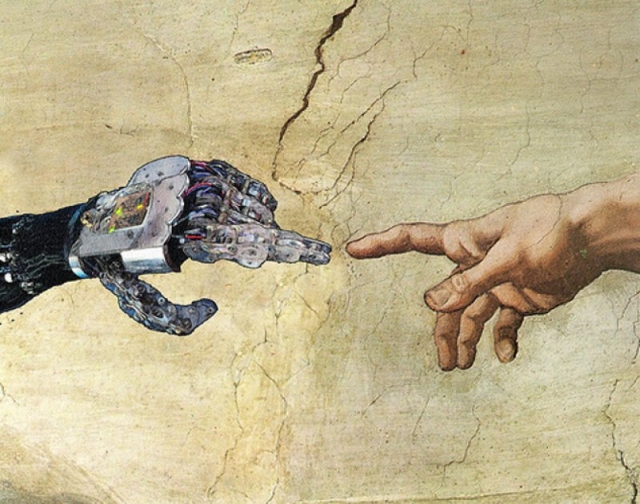
Transhumanism, Lennox argues, is not a technical proposal. It is a religion — and one that stands in direct opposition to the Christian understanding of what it means to be human. Where transhumanism sees human limitation as a problem to be solved, Christianity sees human creatureliness as the context within which dignity, relationship, and redemption become possible. The human person is not a defective machine awaiting an upgrade. We are image-bearers of God, whose limitations are not errors but the very conditions of love, dependence, and growth.
Lennox's most recent book, God, AI and the End of History, extends this argument in depth. The Breakpoint conversation is the place to begin — it is direct, engaging, and specifically oriented toward helping Christians think clearly rather than react fearfully.
A practical resource for your school and classroom
Understanding the theology and philosophy of AI is essential. But Christian school leaders and teachers also need practical wisdom for the daily realities of classrooms in which students are already using AI tools — sometimes wisely, sometimes not, and often in ways that raise genuine questions about learning, integrity, and formation.
Paul Matthews brings a distinctive and invaluable combination of perspectives to this challenge. He is a full-time history teacher at Calvin Christian School in Tasmania, the CEO and co-founder of MyTeacherAide.com, host of the Christian Education Podcast, and the author of A Time to Lead: A Faithful Approach to AI in Christian Education. Schools in our network have benefited from his work, and we are glad to recommend him to you.
Paul's approach is grounded in what he calls the LEAD framework — beginning with "Live under Lordship," the conviction that all decisions about technology, including AI, must be anchored in the sovereignty of Christ. The framework moves through theological foundations to practical principles, classroom strategies, and school-wide policy — making it useful for school leaders developing an institutional response to AI and for individual teachers navigating the classroom reality.
His website — paulmatthews.ai — is the right place to begin. His book A Time to Lead is available through Christian Schools International and is one of the most accessible and practically useful resources currently available for Christian educators at any level of familiarity with AI.
One of the most important things Paul argues — and it echoes directly what Marc de Vries said at IELC and what Magnifica Humanitas insists — is that educators cannot simply ignore AI or pretend it does not exist. Students have already been living with AI tools throughout their schooling. The question is not whether AI is present in Christian schools. It is whether Christian schools will lead their students in using it wisely, or leave that formation to the culture by default.
Where to begin this summer
If you are a school leader or teacher looking for a focused area of professional reflection over the summer, we suggest this sequence:
Start with the Breakpoint podcast. Listen to John Lennox's conversation with John Stonestreet on Navigating AI with a Christian Worldview. It is under an hour and will frame everything else well.
Then read Chapter Four of Magnifica Humanitas. Available free online in multiple languages. Pay particular attention to the sections on "An educational alliance for the digital age" and "The central role of schools." Then, if you can, read the whole encyclical over the summer.
Explore Paul Matthews's work at paulmatthews.ai. If you are responsible for your school's approach to AI — as a leader, a department head, or a classroom teacher — A Time to Lead is the practical companion to the theological foundations above.
Bring the question into your team. When your staff gather in August, consider using the framework from Professor de Vries's IELC presentation as an opening discussion:
- What is technology claiming to do in our students' lives?
- What does it mean to teach with love, wisdom, and faith in this moment?
- What does faithful stewardship of AI look like in our school?
These are not questions with quick answers. But they are exactly the questions that Christian schools are uniquely positioned to ask — and to model for the communities they serve.
updated on June 9, 2026

Digital Citizenship Education from a Christian Perspective
The Council of Europe’s framework, “Easy Steps to Help Learners Become Digital Citizens” (2023), defines three domains for development: Being Online, Well-Being Online, and Rights Online. But what does digital citizenship mean for Christian schools whose mission is grounded in Scripture rather than in secular definitions of the human person and society?
October 2025 Highlights
Thank you for your partnership in the ministry of ACSI Europe! We would like to give you an update on the highlights of our recent activities and also request your prayers for some important upcoming programs.
SLC report 2025
Praise the Lord for His faithfulness and blessings poured out during the ACSI Student Leadership Conferences (SLC) this year! These gatherings brought together students and chaperones from 47 schools across Europe for a time of worship, discipleship, and leadership growth centered on the theme “Leaders Who Love Truth.”
Strengthening Critical Thinking
Christian schools are often intentional about teaching worldview and preparing students to engage with competing ideas. Yet the way we structure this engagement can either nurture deep critical thinking or unintentionally foster shallow habits of argument. Here are some practical tools to support critial thinking in the classroom.
Stronger Together
ACSI Europe exists to equip, inspire, and connect Christian school leaders and educators across Europe. If this article has been helpful, consider sharing it with a colleague or with your school's leadership team.
If this content is valuable for your ongoing work in education, consider joining our growing community of member schools or ministry partners today. For more resources on professional learning and school improvement, visit our articles or blog.
To stay connected to the stories, events, and resources that matter most to your role, update your communication preferences here or subscribe now.
