
Restorative Responses to Challenging Behavior
Course Description
One of the most meaningful expressions of a Christian worldview is how we respond to challenging behavior. As educators and administrators, our responses shape school culture, influence relationships with students and parents, and reflect our core values and beliefs. This course explores how a restorative, trauma-informed approach can help prevent and reduce challenging behavior, while providing a biblically grounded framework for responding effectively when it occurs.
Course Purpose
The purpose of Restorative Responses to Challenging Behavior is to equip teachers and administrators with a biblically grounded framework and practical tools to respond to challenging behavior in ways that address underlying needs, repair harm, and foster community.
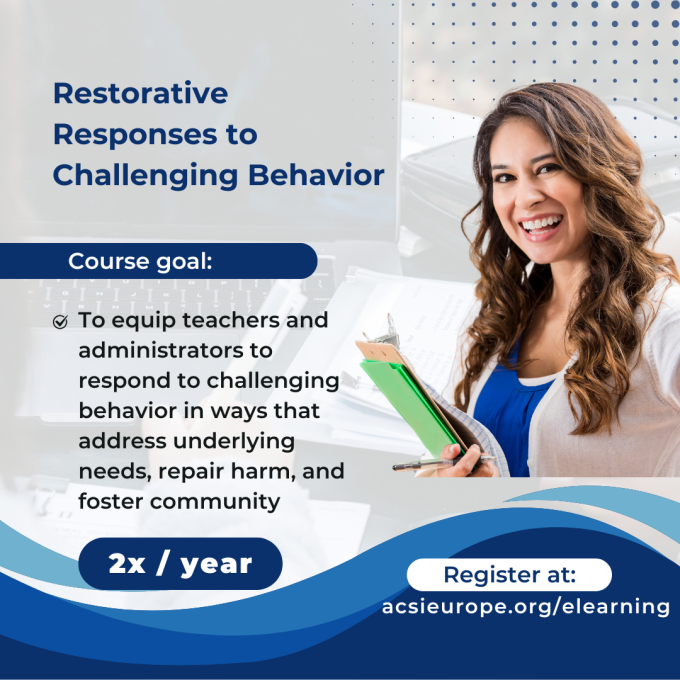
Course Format: online course (at: https://acsieurope.net/moodle )
Course Language: English
Length of Course: 5 weeks (3-4 hours/week)
Register here
This course is available to anyone interested in the course content. You do not need to be a member of ACSI or even be currently teaching. Please contact us for more details or questions.
Participation requirements and costs:
- Time frame and requirements: approx. 3 hours per week for 5 weeks (for fluent English speakers) which equals 15 class hours of instruction
- Course fee: 60 Euro registration fee (payable by credit card) includes an electronic certificate of completion.
- Remember that ACSI member schools in Europe receive 2 complimentary courses each year.
- The course fee includes digital versions of the reading materials and a digital certificate of completion.
Course Objectives -
Participants will be able to…
- Articulate a biblically grounded framework for classroom management/student behavior.
- Identify underlying needs behind challenging behavior.
- Intentionally apply practices that cultivate community.
- Evaluate personal and/or school-wide practices and policies.
- Apply restorative practices to prevent, reduce, and respond to challenging behavior.

Course Offering - Foundations of leadership
Foundations of Christian School Leadership is an eight-week online formation course that guides school leaders from the convictions that shape a their identity through the governance, curriculum, financial accountability, and communication systems that give those convictions institutional form arriving at a final week focused on sustainable, integrative leadership rooted in the leader's ongoing formation in Christ.
In Memory of Bert Vogel
In loving memory - with deep gratitude and firm trust in his Lord and King, ACSI Europe remembers Bert Vogel, who went to be with the Lord after one year of illness on February 14, 2026.
ACSI Day of Prayer 2026
On February 24, 2026, join Christian school leaders, teachers and students around the world for a day of prayer. Resources are provided for schools to organize prayer-centered activities designed to focus our attention on God's presence and provision for His work through global Christian education.
Standing in the Gap
In January 2026, leaders from across Europe gathered in Brussels for the General Assembly of the European Association for Christian Education (EACE). With 44 participants representing 20 countries, the meeting offered a rich space for reflection, strategy, and collaboration at a time when Christian education in Europe faces both growing pressures and new opportunities.
