
Restorative Responses to Challenging Behavior
Course Description
One of the most meaningful expressions of a Christian worldview is how we respond to challenging behavior. As educators and administrators, our responses shape school culture, influence relationships with students and parents, and reflect our core values and beliefs. This course explores how a restorative, trauma-informed approach can help prevent and reduce challenging behavior, while providing a biblically grounded framework for responding effectively when it occurs.
Course Purpose
The purpose of Restorative Responses to Challenging Behavior is to equip teachers and administrators with a biblically grounded framework and practical tools to respond to challenging behavior in ways that address underlying needs, repair harm, and foster community.
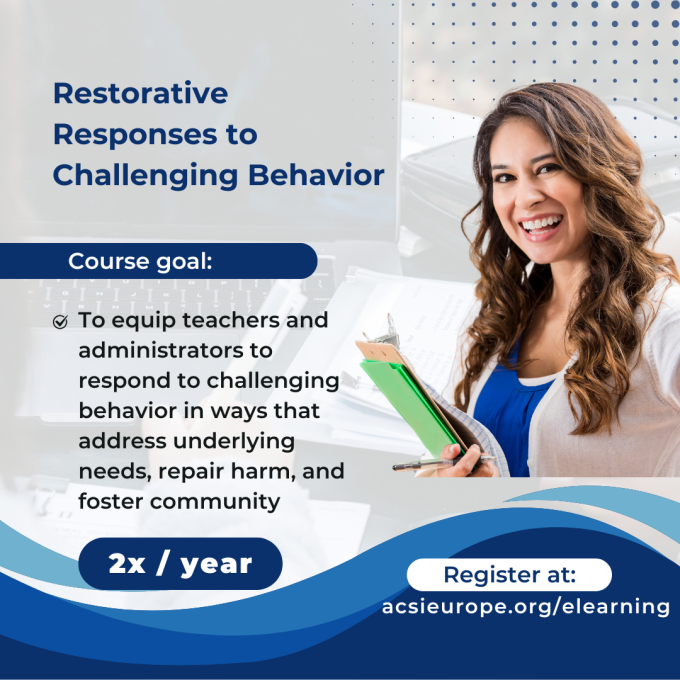
Course Format: online course (at: https://acsieurope.net/moodle )
Course Language: English
Length of Course: 5 weeks (3-4 hours/week)
Register here
This course is available to anyone interested in the course content. You do not need to be a member of ACSI or even be currently teaching. Please contact us for more details or questions.
Participation requirements and costs:
- Time frame and requirements: approx. 3 hours per week for 5 weeks (for fluent English speakers) which equals 15 class hours of instruction
- Course fee: 60 Euro registration fee (payable by credit card) includes an electronic certificate of completion.
- Remember that ACSI member schools in Europe receive 2 complimentary courses each year.
- The course fee includes digital versions of the reading materials and a digital certificate of completion.
Course Objectives -
Participants will be able to…
- Articulate a biblically grounded framework for classroom management/student behavior.
- Identify underlying needs behind challenging behavior.
- Intentionally apply practices that cultivate community.
- Evaluate personal and/or school-wide practices and policies.
- Apply restorative practices to prevent, reduce, and respond to challenging behavior.

The week after SLC
The week after SLC or any event that challenges student growth is a huge opportunity - don't miss it! Many of our students are teenagers in European schools where living out a Christian faith can be difficult, where speaking up takes courage that does not come naturally, where identifying as a Christ-follower may not be received be warmly. How will we as teachers and school leaders engage them in their next steps of faith and leadership?
ACSI Europe Art Show Winners 2026
We would like to congratulate all the wonderful students who participated in our first ACSI Europe Art Show responding to the theme of "Your word is a lamp to my feet and a light to my path.". We were very encouraged to receive over 60 art pieces from schools all across Europe — a remarkable debut for this new tradition.
Poetry Contest Winners 2026
Announcing our first ever ACSI Europe Poetry Contest winners... Students were invited to respond to the theme of "Oh how I love Your law" — drawn from Psalm 119:97 — expressing their faith in their own words, in their own language.
2026 school year in review - Thank You
As another school year comes to a close, we find ourselves pausing — as we should — to ask a question that matters more than any metric or milestone. What has God been doing through Christian schools in Europe this year?
The answer is larger than any one school, conference, country, or organization. It is a story told in classrooms and conference halls, in student testimonies and teacher conversations, in policy discussions at the European Parliament and around the graveside of a faithful servant.
