
Standing in the Gap: What the 2026 EACE General Assembly Means for Christian School Leaders in Europe
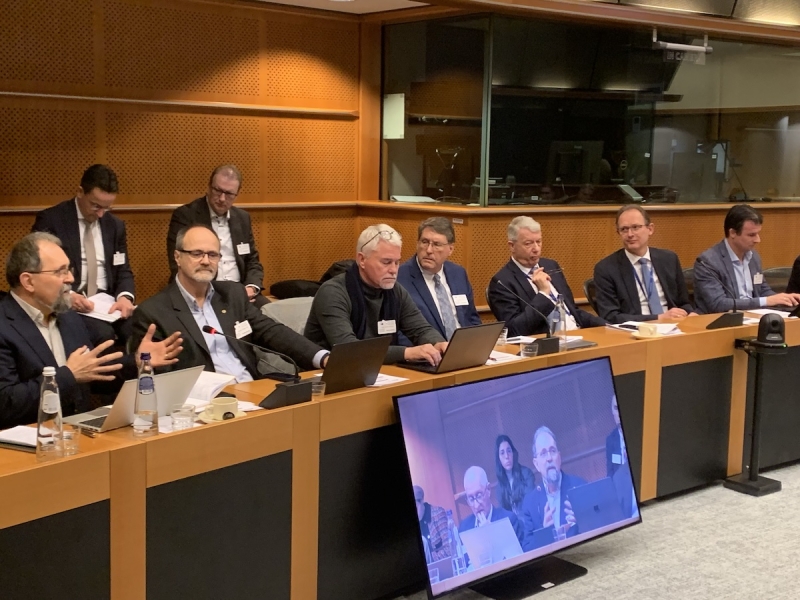
In January 2026, leaders from across Europe gathered in Brussels for the General Assembly of the European Association for Christian Education (EACE). With 44 participants representing 20 countries, the meeting offered a rich space for reflection, strategy, and collaboration at a time when Christian education in Europe faces both growing pressures and new opportunities.
ACSI Europe has participated in this annual gathering since 2013 as a representative organization. This year, Laci Demeter, Paul Madsen, and George Tryfiates (ACSI’s Director of Public Policy and Legal Affairs, based in Washington, D.C.) contributed significantly to the discussions, helping bridge European realities with broader international experience and strategic applications for ACSI member schools.
For school leaders, the conversations in Brussels were not abstract policy debates. They raised deeply practical questions: How do we lead Christ-centered schools faithfully within complex legal and cultural frameworks? How do we respond wisely to EU-level initiatives? And how can we actively and effectively engage in the public sphere for the sake of our students and families?

“Behold the Lamb of God”: Re-centering Our Calling
The assembly opened with a devotional reflection from John 1: “Behold, the Lamb of God.” Andrew’s response to John the Baptist's proclamation, in going to his brother Simon and bringing him to Christ, set the tone for the discussions that followed. Participants were reminded that this is the heart of Christ-centered education: to know Christ and to make Him known. Policies, advocacy, and strategy only have meaning when they serve this greater purpose. Our hope is not ultimately in structures or laws, but in God meeting us, shaping our hearts, and growing His Kingdom through our school communities.
For school leaders, this framing is crucial. Engagement with policy must never eclipse formation of faith, but neither can faithfulness ignore the realities that shape how schools are allowed to operate.
Human Dignity, Education, and the EU Context
A key contribution came from Bert-Jan Ruissen, Dutch Member of the European Parliament, who addressed the work of the EU’s Human Dignity discussions and their implications for education.
Several themes emerged that are directly relevant to Christian schools:
1. Education, Work, and Human Purpose
EU policy discussions increasingly emphasize skills and employability. While competence and professionalism matter, our questions should address our foundational assumptions: Is education only about economic productivity, or about wisdom, calling, and service in light of God’s character and purposes for us?
Christian schools are uniquely positioned to articulate a richer vision of work—as a blessing, rooted in God’s design, serving both neighbor and society. School leaders can help policymakers understand that formation of character and purpose is not opposed to economic contribution; it strengthens it.
2. Harmonization and Hidden Assumptions
Efforts to harmonize education policy across Member States often come through “soft law instruments”—guidelines and frameworks that are not legally binding but gradually shape expectations and practice.
Concerns were raised about the use of undefined terms such as “gender equality” and “children’s rights”without adequate protection for:
- parental authority
- freedom of belief
- freedom of education
- conscience rights of teachers and counselors
Because these terms are often vague, schools may not know when they are allegedly crossing a line. As was emphasized: law must be foreseeable. Rights cannot be protected—and alleged crimes cannot be justly enforced—if they are not clearly defined.
3. A Changing Cultural Climate and Our Responsibility
Encouragingly, there is evidence of a shift in the European climate. More voices are willing to question radical secular assumptions, and there are concrete examples of successful resistance to unhealthy interpretations of human rights.
Christian schools can play a role here by:
- sharing stories of good practice
- articulating positive visions of dignity, freedom, and education
- resisting caricatures that label Christian convictions as “anti-democratic” or “anti-human rights”
In a pluralistic society, excluding Christian perspectives actually undermines pluralism itself. This is incredibly important when we realize that the Bible is the foundation on which these democratic societies were built, valuing both the rights of individuals and the freedom to live out those values in the public square.
EACE Strategy: Strengthening the Voice of Christian Education
In the afternoon, Pieter Moens presented an update on EACE’s strategic development:
- Official Foundation status is complete (registered in the Netherlands, banking in Germany, website online).
- EACE is now listed as an EU advocacy group, strengthening its ability to engage policymakers.
- Governance structures are being streamlined, with an Educational Council in place and a Parental Council planned.
For school leaders, this matters because effective advocacy requires coordination. No single school can monitor EU developments alone, but together, Christian schools can have a clearer, more credible voice.
Key policy areas identified for ongoing attention include:
- hate speech legislation
- LGBT-related policies
- transgender ideology
These are not merely political issues; they directly affect school ethos, staff expectations and hiring, curriculum, and parental trust.
Digital Citizenship Education: A Third Way Forward
One of the most practical sessions focused on Digital Citizenship Education (DCE), presented by Christian Baldauf (VEBS Akademie, Germany) and Paul Madsen (ACSI Europe).
DCE was promoted by the Council of Europe in 2025 as part of the Year of Education. While not legally binding, such guidance can strongly influence expectations placed on schools.
Christian schools often respond in one of two ways:
- adopting the guidance uncritically, or
- ignoring it altogether.
The session proposed a third approach: critical engagement from a biblical worldview.
Key questions included:
- What does “citizenship” mean from a Christian perspective?
- Are EU definitions too narrow, focusing only on rights without responsibility or transcendent purpose?
- Can existing tools be reshaped to align with our school’s Christ-centered mission?
The result was a practical framework for DCE that uses EU language where helpful, but re-grounds it in biblical truth. This enables teachers to address digital life thoughtfully without compromising the school’s convictions.
Resources shared include: Digital Citizenship Education from a Christian perspective (on the ACSI Europe website)

Standing in the Gap: Advocacy as a Christian Calling
The assembly included with a compelling contribution from George Tryfiates, who addressed why advocacy matters for Christian education.
Drawing on biblical imagery, he described schools as those who “stand in the gap”—not primarily against an enemy, but as intercessors, asking God for time and space to bring children back into right relationship with Him. This imagery is taken from Ezekiel 22:23-31 where God is looking for leaders who will intercede on behalf of the people.
ACSI’s approach to public policy includes:
- defending against harmful laws
- promoting good and just public policy
- building respectful relationships with lawmakers
- working in coalitions to amplify influence
- encouraging school leaders to engage locally
School leaders, he emphasized, possess on-the-ground knowledge that policymakers need. Parents’ voices matter. Inviting local officials into schools and building trust at the local level often has long-term impact.
A closing devotional from Laci Demeter reemphasized the reality of where we are and where we are going. "Ebenezer" was the name of the stone set up to remind the Israelites of God's provision and protection while also pointing forward to the need for continued trust and guidance from Him. "Thus far the Lord has helped us." (I Samuel 7:12)
What This Means for You as a School Leader
The 2026 EACE General Assembly reinforced a vital truth: faithful Christian education in Europe requires both deep conviction and wise engagement.
For school leaders, practical next steps may include:
- regularly grounding leadership decisions in biblical purpose, not fear
- staying informed about non-binding EU guidance that may still shape expectations
- engaging critically, not reactively, with policy language
- building relationships with parents and local officials
- using networks like ACSI Europe and EACE to avoid isolation
Christian schools are not called to withdraw, nor to conform uncritically, but to bear faithful witness, confident that God is at work in and through His people, even in complex times.
“Behold the Lamb of God.” This remains our starting point and our hope.
based on notes taken by Paul Madsen, Jan. 19, 2026

Course Offering - Restorative Responses to Challenging Behavior
One of the most meaningful expressions of a Christian worldview is how we respond to challenging behavior. As educators and administrators, our responses shape school culture, influence relationships with students and parents, and reflect our core values and beliefs. This course explores how a restorative, trauma-informed approach can help prevent and reduce challenging behavior, while providing a biblically grounded framework for responding effectively when it occurs.
Flourishing Communities: A Restorative Approach
Restorative practices provide a framework for addressing both individual behavioral challenges and interpersonal conflict, but it is even more than that. “The restorative approach is a way of being with others, a relational approach to prevention and intervention”
SLC-UK funding campaign
Help Launch the First Student Leadership Conference in the UK and equip the next generation to lead with truth and courage! Every year, students across Europe come to the Student Leadership Conference (SLC) searching for something deeper: truth, purpose, and the courage to live for Christ.
March 2026 Highlights
In early March, Christian school leaders from across Europe and beyond gathered in Budapest for the International Educational Leadership Conference (IELC 2026) under the theme “On Mission, On Guard.” Over 3 days of learning, prayer, and deep conversation, participants were encouraged not only to lead well today but to endure faithfully in the long-term calling of Christian education.
