
Restorative Responses to Challenging Behavior
Course Description
One of the most meaningful expressions of a Christian worldview is how we respond to challenging behavior. As educators and administrators, our responses shape school culture, influence relationships with students and parents, and reflect our core values and beliefs. This course explores how a restorative, trauma-informed approach can help prevent and reduce challenging behavior, while providing a biblically grounded framework for responding effectively when it occurs.
Course Purpose
The purpose of Restorative Responses to Challenging Behavior is to equip teachers and administrators with a biblically grounded framework and practical tools to respond to challenging behavior in ways that address underlying needs, repair harm, and foster community.
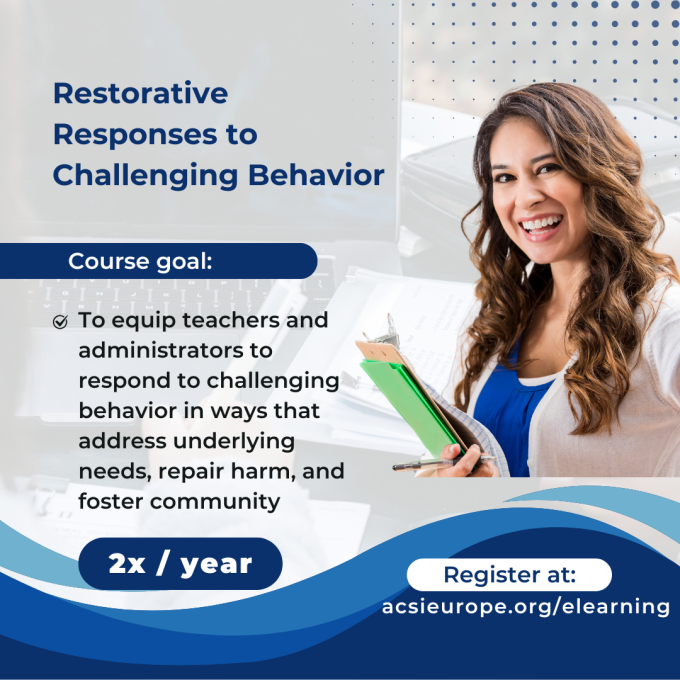
Course Format: online course (at: https://acsieurope.net/moodle )
Course Language: English
Length of Course: 5 weeks (3-4 hours/week)
Register here
This course is available to anyone interested in the course content. You do not need to be a member of ACSI or even be currently teaching. Please contact us for more details or questions.
Participation requirements and costs:
- Time frame and requirements: approx. 3 hours per week for 5 weeks (for fluent English speakers) which equals 15 class hours of instruction
- Course fee: 60 Euro registration fee (payable by credit card) includes an electronic certificate of completion.
- Remember that ACSI member schools in Europe receive 2 complimentary courses each year.
- The course fee includes digital versions of the reading materials and a digital certificate of completion.
Course Objectives -
Participants will be able to…
- Articulate a biblically grounded framework for classroom management/student behavior.
- Identify underlying needs behind challenging behavior.
- Intentionally apply practices that cultivate community.
- Evaluate personal and/or school-wide practices and policies.
- Apply restorative practices to prevent, reduce, and respond to challenging behavior.

Safeguarding the Human Person in the Time of Artificial Intelligence
There is a question running through every staffroom, every school board meeting, and every teacher's planning session right now, whether it is spoken aloud or not: What does faithfulness look like in the age of artificial intelligence?
Flourishing Communities: A Restorative Approach
Restorative practices provide a framework for addressing both individual behavioral challenges and interpersonal conflict, but it is even more than that. “The restorative approach is a way of being with others, a relational approach to prevention and intervention”
SLC-UK funding campaign
Help Launch the First Student Leadership Conference in the UK and equip the next generation to lead with truth and courage! Every year, students across Europe come to the Student Leadership Conference (SLC) searching for something deeper: truth, purpose, and the courage to live for Christ.
March 2026 Highlights
In early March, Christian school leaders from across Europe and beyond gathered in Budapest for the International Educational Leadership Conference (IELC 2026) under the theme “On Mission, On Guard.” Over 3 days of learning, prayer, and deep conversation, participants were encouraged not only to lead well today but to endure faithfully in the long-term calling of Christian education.
