
Living the Mission:
Insights from Christian School Leaders Across Europe (Part 2)
At the International Educational Leaders Conference (IELC 2026), Christian school leaders from across Europe reflected on a simple but searching question: How closely do our daily practices reflect the mission we profess?
The survey results highlighted an encouraging reality—schools remain deeply committed to their Christian identity and purpose. Yet they also revealed a recurring leadership challenge: translating strong conviction into consistent practice.
As leaders reflected on the findings, three structural needs emerged that help explain why mission alignment can be difficult to sustain over time.
Three Structural Needs for Mission Alignment
The first is teacher formation.
Teachers shape the lived culture of a school more than any policy or strategic document. Yet many leaders acknowledged that educators often need greater support in understanding how to integrate biblical worldview into everyday teaching. Without intentional formation, mission alignment risks remaining aspirational rather than visible in classroom practice.
The second need is for leadership decision frameworks that consistently reference mission.
Strategic choices about staffing, finances, admissions, and discipline communicate priorities to the entire school community. When mission is clearly connected to these decisions, alignment becomes tangible. When it is not, schools can gradually drift into reactive patterns shaped more by pressure than by purpose.
 |
|
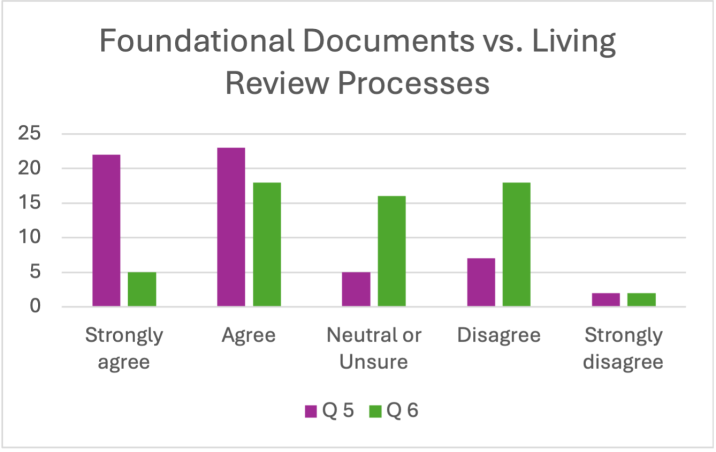
Q5 - Our mission and foundational documents have been reviewed within the last 3-5 years with active leadership involvement. Q6 - We have a defined process for reviewing our mission and vision that includes input from across the school community. |
The third structural need is regular rhythms of mission review.
Many schools reported reviewing foundational documents within recent years, yet fewer had defined processes for doing so. Without intentional review, mission statements can move from guiding principles to background assumptions. Healthy leadership teams create space to reflect together, ensuring that current practices still reflect their founding vision.
Questions for Leadership Teams
These insights raise important questions for ongoing leadership reflection:
- If someone observed our school for a week, what would they conclude our true priorities are?
- How intentionally do we equip teachers to connect faith and learning in their classrooms?
- When we make strategic or financial decisions, how clearly do we reference our mission?
- When did our leadership team last review the practical implications of our mission together?
These questions are not designed to create pressure, but clarity. Alignment often begins with honest conversation.
Regional Insights Across Europe
Survey responses also revealed differences shaped by context. Schools in Western Europe frequently reported high clarity of mission but greater hesitation about consistent implementation, often influenced by financial pressures and increasingly secular environments. Emerging school movements in Spain, France, and the Balkans expressed strong enthusiasm and vision, while also acknowledging limited institutional infrastructure and heavy leadership workloads.
By contrast, many schools in Eastern Europe described stronger operational alignment between belief and practice, supported by traditions of collaboration, regional conferences, and shared resources developed over decades of rebuilding Christian education.
These differences highlight an important reality: mission alignment is not simply a theological issue—it is also an organizational one. Schools that strengthen collaboration across regions and develop intentional routines for reflection are better positioned to sustain their vision over time.
Looking Ahead
The survey findings suggest that reflection alone is not enough. Sustained mission alignment requires intentional systems that help schools move from conviction to consistent practice.
In the next and concluding article, we will explore practical pathways that leadership teams can use to build these rhythms into the life of their school—creating structures that support faithful stewardship, strategic clarity, and long-term impact.

Spain's Christian Schools Take Steps Toward a National Federation
Evangelical Christian schools in Spain are preparing to take a significant step together. At the 5th Forum on Christ-Centred Education, held in Barcelona on 30–31 October 2026, educators will be presented with a project to form a national federation of Protestant Christian schools.
The week after SLC
The week after SLC or any event that challenges student growth is a huge opportunity - don't miss it! Many of our students are teenagers in European schools where living out a Christian faith can be difficult, where speaking up takes courage that does not come naturally, where identifying as a Christ-follower may not be received be warmly. How will we as teachers and school leaders engage them in their next steps of faith and leadership?
ACSI Europe Art Show Winners 2026
We would like to congratulate all the wonderful students who participated in our first ACSI Europe Art Show responding to the theme of "Your word is a lamp to my feet and a light to my path.". We were very encouraged to receive over 60 art pieces from schools all across Europe — a remarkable debut for this new tradition.
Poetry Contest Winners 2026
Announcing our first ever ACSI Europe Poetry Contest winners... Students were invited to respond to the theme of "Oh how I love Your law" — drawn from Psalm 119:97 — expressing their faith in their own words, in their own language.
